Waterbury, Connecticut: A Brass City Travel Guide
Waterbury, Connecticut
Part of The Burys of Connecticut
Pictures from Waterbury
See all 5 photos →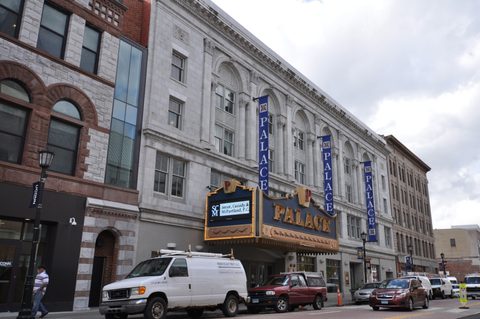
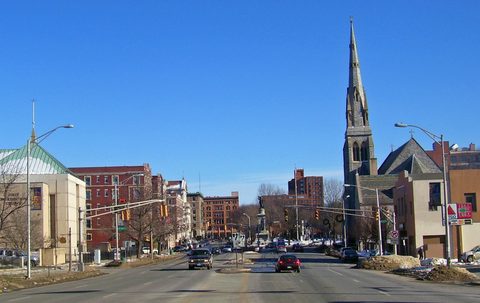
Waterbury earned its nickname the honest way: by 1840, America's entire brass industry was concentrated in the Naugatuck Valley around this city, and at its peak the brass mills employed some 50,000 people. The factories are quieter now, but the wealth they made built a downtown worth a day of anyone's time — a Thomas Lamb movie palace, a museum-on-the-Green with 10,000 buttons, and a clock tower you can see from the highway. Add a food scene that never stopped being old-school — grinders since 1922, hot dogs since 1937 — and the Brass City makes a rewarding, unpretentious stop on any western Connecticut trip.
-
sight
A 1922 Thomas Lamb movie palace restored for $30 million and reopened in 2004 — one of only two survivors of Sylvester Poli's theater empire. Check the Broadway series schedule before you book the trip.
-
sight
Art upstairs, brass and buttons downstairs: the museum founded in 1877 holds the industrial story of the Naugatuck Valley, including the Waterbury Button Museum's 10,000-plus buttons.
-
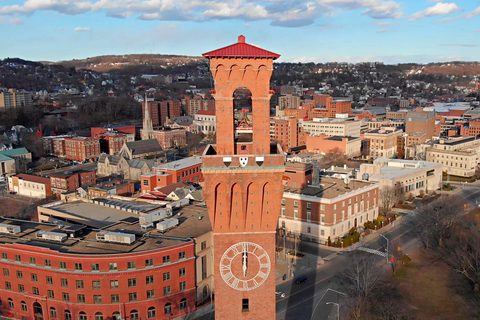
The 1909 station's clock tower is the city's signature landmark — walk over for the photo.
-
walk
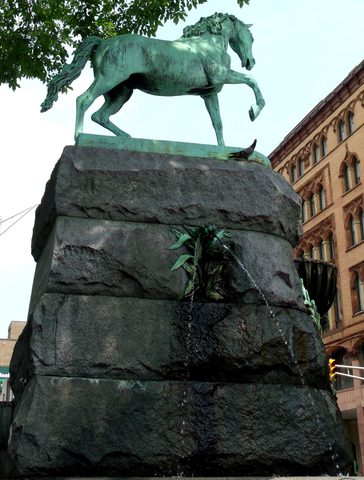
Start a downtown loop at the Welton Fountain on the Green, then walk to the Palace and the Mattatuck — everything is within a few blocks.
-
sight
The 18-acre hillside park of miniature biblical scenes, closed in 1984 and reopened in 2014, is one of Connecticut's strangest and most memorable sights. Daylight hours.
-
sight
A Waterbury theatre staging musical theatre, comedy, and concert tributes.
-
The white-tablecloth stalwart of Bank Street — classic Italian-American with a proper bar. Dinner from 5, closed Sundays for the bar.
-
Cold and hot grinders, Italian wedding soup, and cannoli, with two locations in the city.
-
food
Hot dogs, burgers, and curly fries, with three locations around the city.
-
food
A Manor Avenue bakery: cakes, cookies, cupcakes, biscotti, and pignoli.
-
food
A Thomaston Avenue taproom pouring nine house beers, with food trucks and an in-house menu.
-
The downtown base: steps from the Palace Theater and the Green, which is exactly where you want to be.
How Waterbury became the Brass City
Settled in 1674 as Mattatuck Plantation and incorporated as a town in 1686, Waterbury industrialized around one metal. By 1840 the entire American brass industry was localized in the Naugatuck Valley, led by giants like Scovill Manufacturing, Anaconda American Brass, and Chase Brass & Copper — at the WWII peak, about 10,000 people worked at Scovill alone, in mills covering more than two million square feet. The Waterbury Clock Company (ancestor of Timex) was making 20,000 clocks and watches a day by the end of the 19th century, and its 1933 Mickey Mouse watch sold over 11,000 units on day one. Waterbury inventors gave the world the can opener (Ezra J. Warner, 1858) and the machine-made paper clip (William D. Middlebrook, 1899). Employment peaked around 50,000 before falling to under 5,000 by the 1980s — the Mattatuck Museum tells the whole arc.
Getting there and around
Waterbury sits on I-84 in west-central Connecticut, roughly halfway between Hartford and Danbury, and has its own Metro-North branch line into Union Station. Downtown — the Green, the Palace, the Mattatuck — is compactly walkable; Holy Land USA and the brewery are short drives.
Frequently asked questions
- Why is Waterbury called the Brass City?
- By 1840 America's entire brass industry was concentrated in the Naugatuck Valley around Waterbury, and brass employment peaked near 50,000 workers. The nickname parallels Meriden (Silver City) and New Britain (Hardware City).
- Is the Palace Theater still open?
- Yes — it operates year-round with a Broadway series, comedy, and concerts, and offers guided tours. It reopened in 2004 after a $30 million restoration.
- What is the one must-see in Waterbury?
- The Mattatuck Museum on the Green: American art plus the definitive telling of the brass story, with the Waterbury Button Museum inside. Pair it with a walk to the Palace Theater.
- Where should I stay in Waterbury?
- The Courtyard by Marriott Waterbury Downtown at 63 Grand Street is the main full-service downtown hotel, steps from the Palace Theater.
- Is Holy Land USA open?
- Yes — after closing in 1984 it was revived and reopened to the public in 2014, and is open during daylight hours.
Foliage
Still green this week · estimated peak Oct 21–27
Derived from the Connecticut DEEP fall foliage map. DEEP's map is a climatological estimate last published in 2023; it describes a normal year, not this one. Stage names are ours. See the statewide forecast.
We can't find the internet
Attempting to reconnect
Something went wrong!
Hang in there while we get back on track
What travelers think
Connected pages
Nearby
- Middlebury, Connecticut: Quassy, the Greenway, and the Quiet Side of the Valley · Middlebury, Connecticut
-
Plymouth, Connecticut: Eli Terry and the Lock Museum of America
· Plymouth, Connecticut
The two towns share a border
-
Thomaston, Connecticut: A Clockmaker's Name on the Naugatuck
· Thomaston, Connecticut
The two towns share a border
-
Cheshire, Connecticut: Barite Mines and Bedding Plants
· Cheshire, Connecticut
The two towns share a border
-
Naugatuck, Connecticut: Vulcanized Rubber and Naugahyde
· Naugatuck, Connecticut
Naugatuck was incorporated in 1844 from portions of Waterbury, and its Metro-North station is the next stop south of Waterbury on the Waterbury Branch.
-
Prospect, Connecticut: The Highest Ground in New Haven County
· Prospect, Connecticut
Prospect was formed partly from Waterbury's "South Farms" section, and Waterbury is one of Prospect's four bordering towns.
- Watertown, Connecticut: Sewing Machines and the Old Leatherman's Loop · Watertown, Connecticut
-
Wolcott, Connecticut: Farmingbury's Hilltop Reservoirs
· Wolcott, Connecticut
Wolcott separated from land belonging to Waterbury, and the town's own guide treats Waterbury as directly next door.
Shared history
-
Middlebury, Connecticut: Quassy, the Greenway, and the Quiet Side of the Valley
· Middlebury, Connecticut
Middlebury (1807) was assembled partly from Waterbury land.
Same region
-
Litchfield, Connecticut: The First Law School and a Quiet Green
· Litchfield, Connecticut
Waterbury is the nearest Metro-North branch terminus to Litchfield.
-
Meriden, Connecticut: Silver City and the Steamed Cheeseburger
· Meriden, Connecticut
Two central Connecticut manufacturing cities, roughly twenty miles apart.
See also
-
Midtown, Manhattan: Terminal City and the Tallest Tower
· Midtown, New York
Metro-North's Waterbury Branch connects to the New Haven Line into Grand Central Terminal.